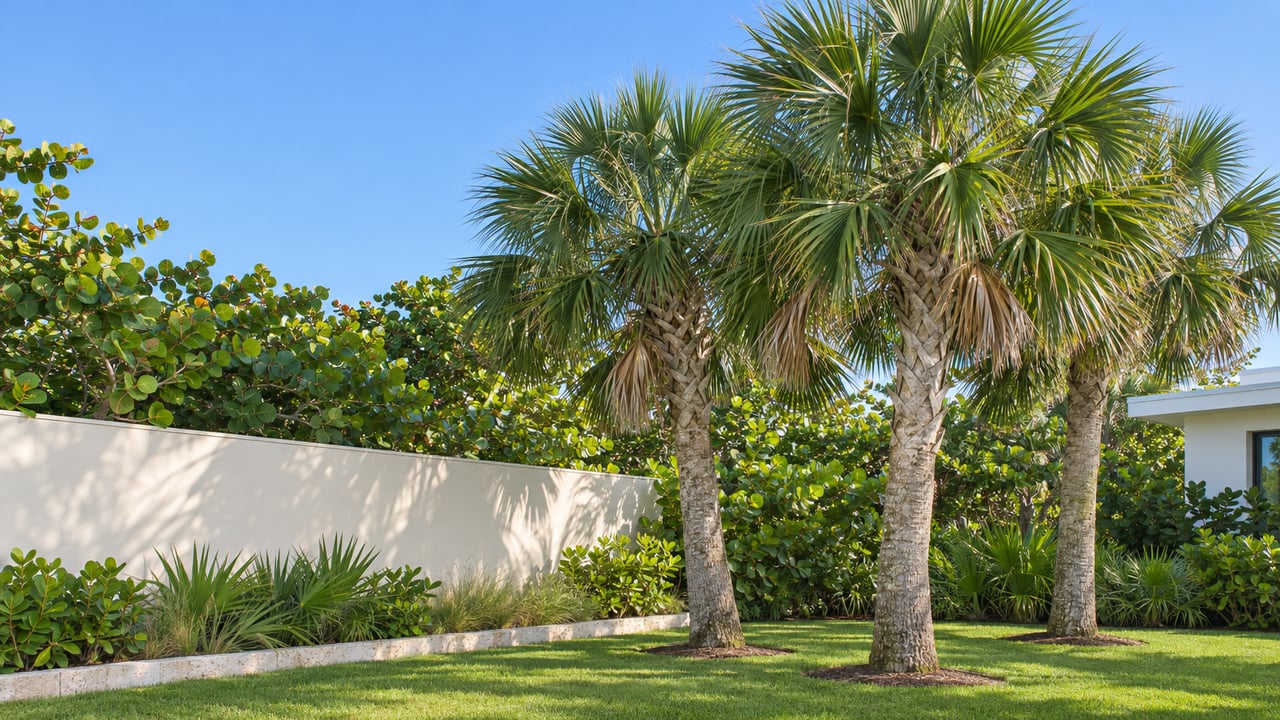
On Jupiter Island, a crew has come onto private lots three times a year to inject palms with antibiotic at Town expense, for longer than most current owners have owned their homes. The schedule comes from Ordinance No. 118, adopted March 19, 1975. That ordinance declared lethal yellowing "a grave and dire emergency" that threatened every palm in town. It required that every susceptible palm, on private and public land alike, be inoculated every 120 days "until the threat had passed."
In the Town Attorney's November 2 memo to the Commission, the program's history gets four words: "The program never ended." Now it is set to end. Ordinance No. 427 repeals the whole lethal yellowing article of the Town Code. It was on the November 12 Town Commission agenda for first reading, and the draft sets the second and final reading for December 17, 2026. Once the ordinance takes effect, palm disease care on a private lot becomes the owner's job. The disease owners now need to watch for most closely is one the 1975 ordinance never named.
Why the Town Is Stepping Back
The repeal rests on field data gathered this year. In 2026, the Town's Public Works Department, UF/IFAS, and the Town's consulting arborist ran a monitoring program at sites across the island. Over four months of trapping, they found the insect that spreads lethal yellowing at only one location, and lab tests of the samples "found no lethal yellowing disease."
The Commission received those results in late October. By consensus, it directed that mandatory treatment of private palms end, that seasonal monitoring continue, and that the Town keep treating its own palms as a budgeted program. In the draft ordinance, the Commission finds that "the emergency declared in 1975 no longer exists."
That finding is about lethal yellowing, the disease the 1975 article was written for.
What Moves From the Town to the Owner
The memo spells out what the repeal changes on private property. The changes go beyond the injections.
| Issue | Under the 1975 article | After repeal, as drafted |
|---|---|---|
| Antibiotic treatment of private palms | Town-funded, every 120 days | Ends; any treatment is the owner's decision |
| Town right of entry to treat palms | Yes, under § 16-56 | Ends |
| Town palms and rights-of-way | Treated under the article | Monitored and treated as a budgeted Town program |
| Dead susceptible palm on private land | Owner must remove it after five days' notice, or the Town removes it and files a lien | That duty and remedy go away with the article |
| Dead tree visible from the road or an adjoining improved property | Nuisance | Still a nuisance under § 9-22(2), with notice, abatement, and a possible lien |
| Dead palm not visible from those places | Covered by the article | "Will not technically be a Code violation" |
| Bringing susceptible palms onto the island | § 16-61 bars them unless grown in town or certified by the state as free of lethal yellowing | Town rule ends; nursery stock is regulated by the state under Chapter 581, Florida Statutes |
The memo also gave commissioners an option. They could keep §§ 16-57, 16-59, and 16-60, the dead-palm removal provisions, and repeal the rest. The final text could still change before December 17, so the right-hand column describes the draft. The ordinance takes effect on adoption.
The Disease the 1975 Rule Never Named
Lethal yellowing was the threat when Ordinance 118 was written. UF/IFAS now tracks a second phytoplasma disease, lethal bronzing, which was formerly called Texas Phoenix palm decline. The pathogen behind it is genetically distinct from the one that causes lethal yellowing. UF/IFAS's lethal bronzing fact sheet, reviewed in August 2025, lists both Martin County and Palm Beach County among the counties where the disease has been confirmed. That is a county-level confirmation for the area around Jupiter Island.
The same fact sheet lists 21 confirmed host species. Several of them show up often in island landscapes:
- Sabal palmetto, the cabbage palm
- Cocos nucifera, the coconut palm
- Phoenix canariensis, P. dactylifera, P. roebelinii, and P. sylvestris
- Adonidia merrillii, Bismarckia nobilis, and Syagrus romanzoffiana
The cabbage palm matters most for anyone thinking about replanting. In its lethal yellowing publication, last revised in December 2024, UF/IFAS lists species on which lethal yellowing has not been reported as replacement options. They are the cabbage palm, the royal palm, the Paurotis or Everglades palm, and thatch palms. UF/IFAS also lists the cabbage palm as a lethal bronzing host. A replacement chosen to avoid lethal yellowing can still be exposed to lethal bronzing.
The two diseases are also handled differently once a palm shows symptoms. For lethal yellowing, UF/IFAS describes trunk-injected oxytetracycline every four months as prevention and as early therapy. It says palms with more than 25% of their leaves discolored, or with a dead bud, should be removed. For lethal bronzing, UF/IFAS says symptomatic or positive palms should be removed immediately, because the label rate of the antibiotic is not enough to reverse symptoms. Its guidance is to test nearby palms that look healthy and to inject the ones that test negative every three to four months, for at least two years, as prevention. Even for lethal yellowing, UF/IFAS cannot say how long treatment has to continue, and reinfection is possible while the disease is still around.
So the Town's injection schedule has covered private palms up to now, and that coverage ends when the article is repealed. For lethal bronzing, the guidance is to test first and remove positive palms quickly. Once the Town stops treating private palms, those steps are up to each owner.
Getting a Palm Checked
UF/IFAS has a published process for owners who notice discolored fronds or want to test a palm before deciding on treatment. The Plant Diagnostic Center sample guidelines, updated in December 2024, lay out the order.
- Email the center before sampling, and send photos of the palm.
- Collect the sample before any antibiotic treatment. A dead palm should not be sampled.
- Collect at least two tablespoons of interior wood shavings. Bag them without touching them by hand, label the bag, refrigerate it, and ship it promptly.
- Budget for the test. The center's pricing guide lists $60 for PCR detection of palm phytoplasmas, which covers lethal yellowing and lethal bronzing, and $80 for PCR plus culturing. It also lists $100 to pool up to 10 samples into one phytoplasma PCR result, which can make sense on a lot with a long row of the same species.
The center is at 2570 Hull Rd in Gainesville, phone (352) 392-1795. UF materials also send some palm samples to the Fort Lauderdale Research and Education Center, so it is best to confirm the receiving lab by email before shipping.
For help closer to home, UF/IFAS Extension Martin County is at 2614 SE Dixie Hwy. in Stuart, phone (772) 288-5654. Its Master Gardener Help Desk is free. It takes walk-ins during business hours, answers questions by phone, and accepts plant photos at [email protected].
Owners who want to keep up injections once the Town stops will be making their own arrangements. The Florida Department of Agriculture and Consumer Services sets the rules on who may apply pesticides, and where, and its pest control FAQ is the place to check them for your situation. UF/IFAS adds that the antibiotic should be used according to the directions on its label. This post is general information, not legal or professional advice. Confirm what applies to your property with FDACS, the Town, an arborist, or the Extension office.
Where the Town's Role Continues
The repeal does not take the Town out of palm health. Section 3 of Ordinance 427 confirms that the Town Manager has authority, within the Commission's budget, to monitor for the disease and the insect that carries it, to treat or remove palms on Town property and in rights-of-way, and to abate nuisances under Chapter 9. The Town will keep watching for disease and caring for its own palms along the roadsides. Palms on private lots become each owner's responsibility. The draft ordinance sets December 17 for the second and final reading, the last public step before adoption.
Whether the palms on your lot have been treated every 120 days since before you bought the property, or a dead palm in the side yard can now stay out of the code's reach, the next few months are a good time to know what you have. If you are deciding whether to replant, remove, or redesign a palm-heavy landscape on Jupiter Island, Premier Properties of South Florida can walk the property with you and connect the work to our in-house team at First Premier Builders. Schedule a consultation and we'll help you plan it.