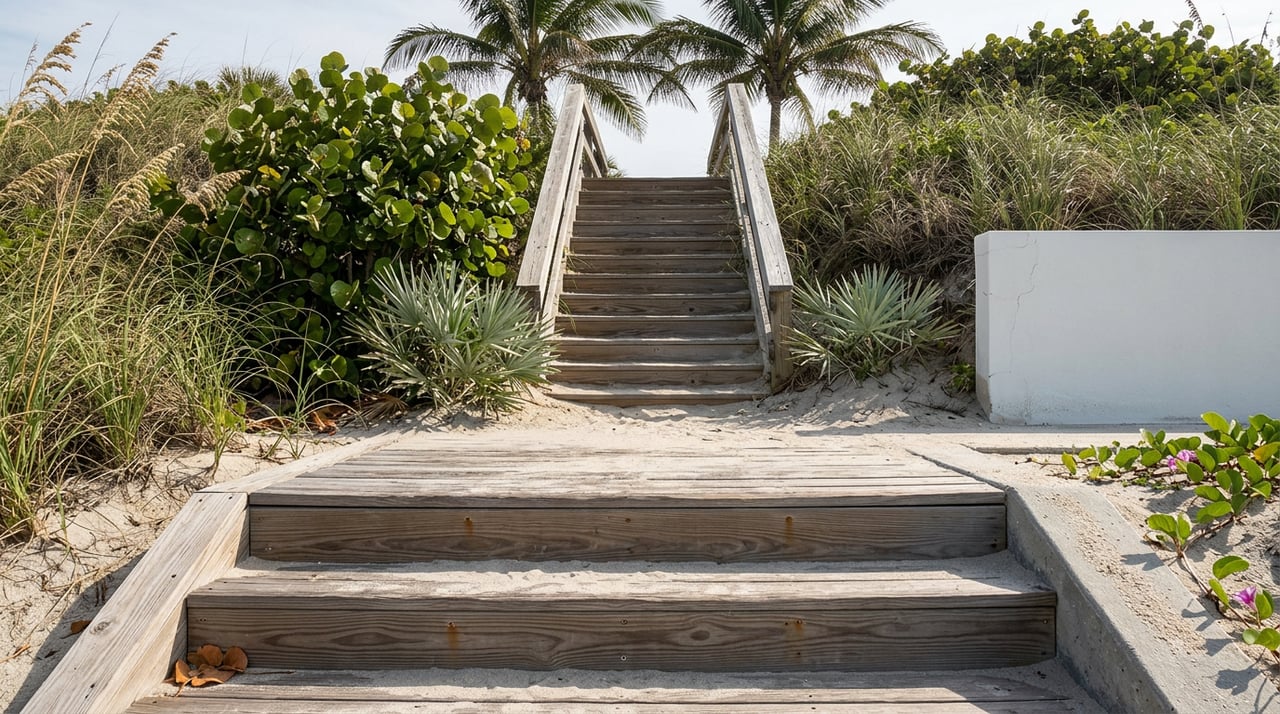
If you spent April walking either of the two brick paths to the water, you probably noticed the dredge pipe running along the inlet, the barge anchored offshore, the low hum of machinery that didn't stop for weeks. Then it stopped, the equipment left, and the beach at the end of your walkway looked exactly the way it did before. That's not a coincidence, and it's not a project that fell short. It's geography doing what geography does, and it explains why the thing that actually changed your daily walk to the water this year wasn't a regional engineering project at all. It was a $38,000 line item the Town Commission approved on a Monday night in February.
What the Dredge Actually Moved
The project you watched from the beach was the Jupiter Inlet District's 2026 Sand Trap Dredging and Beach Nourishment effort, awarded to Atlantic & Gulf Dredging. The scope was substantial: crews pulled approximately 176,000 cubic yards of sand by hydraulic cutter suction dredge from the sand trap inside Jupiter Inlet and pumped the material to the beach south of Jupiter Inlet, with the dredging and placement activities completed on April 26, 2026. That sand trap sits in a specific, engineered spot, a 6.58-acre basin located 1,000 feet west of the inlet mouth, dredged for bypass onto beaches south of the inlet to counter erosion and ensure safe passage.
The project isn't cosmetic. It's the district's answer to a physical problem that predates anyone currently on Ocean Drive: sand moves in constant, natural motion along the coast, and the construction of inlets in the early 20th century interrupted the natural north-to-south flow of sand known as littoral drift, increasing erosion. Every few years, the district catches the sand that piles up on the north side of that interruption and trucks it, by pipe, back into the system on the south side. It's a well-run, necessary piece of coastal infrastructure. It's also, by design, not aimed at your stretch of shoreline.
Why South, Not North
Here's the part that doesn't show up in the press release. The town of Jupiter Inlet Colony is situated toward the north bank of the Jupiter Inlet, at the southernmost tip of Jupiter Island. The sand trap sits just offshore, and the sediment it collects is on its way south, pulled by the same littoral drift the district is fighting. When the dredge pumps that sand back onto the beach, it goes to the downdrift side, south of the inlet, toward Jupiter Beach Park and Carlin Park. Your beach, on the updrift side, isn't part of that fill template. It never has been, in any of the district's recent nourishment cycles.
This is worth sitting with for a second, because it reframes a question a lot of residents were probably asking this spring. The beach didn't fail to get wider because the project underdelivered. It didn't get wider because the sand was never headed your way to begin with. If your stretch of shoreline is going to see engineered relief, it's going to come from a different mechanism, and this year, it did.
The Stairs Nobody Announced
At the Town Commission's regular meeting on February 9, 2026, a Monday, held at the Beach Club at 244 Ocean Drive, commissioners took up an item to construct new stairs at the North Walkway Access. The original contractor could not take on the project, so the commission approved a $38,000 proposal instead, funded from savings on the observation deck project and budgeted road funds, passing 5 to 0.
That's a small number next to 176,000 cubic yards, and that's exactly the point. The regional project moves sand by the barge-load and answers to the Army Corps of Engineers and the Florida Department of Environmental Protection. The stair project answers to five people sitting in the Beach Club on a February night, working with whatever the town has already set aside. One is coastal engineering at a scale most residents will never see up close. The other is the actual set of steps under your feet, funded because a bigger job fell through and the town found the money somewhere else in its own budget.
If you've been wondering why the walkway felt a little different this summer, that's your answer. It wasn't the beach. It was the stairs getting there.
The Walkway Is Doing More Work Than You Think
The town's own police activity reporting gives a sense of just how much daily attention these two access points receive. In a single month this summer, the department recorded 322 documented service activities, including 182 walkover checks, 20 house checks, and 18 Beach Club checks.
More than half of everything the police department logged that month was a walkover check. In a town with two beach access paths, that narrow strip of brick and sand accounts for more routine attention than anything else the department tracks.
That's not a statistic most residents ever see, because it lives in a monthly report buried in a commission agenda packet, not on a sign at the beach. But it says something real about the shape of daily life here. The walkways aren't just how people get to the water. They're the piece of town infrastructure that gets checked on, patrolled, and budgeted for more consistently than almost anything else on the map.
The Calendar Still Runs on Ocean Drive
None of this happens in isolation from the town's social rhythm, either. The same Beach Club that hosted the February commission meeting where the stairs were approved is also where the town gathers every summer: this year's Fourth of July Celebration ran from 3 to 7 PM at the Beach Club, with the parade stepping off at 3 PM. It's the kind of fixture that doesn't need a press release, because everyone who lives here already knows it's coming.
The commission has also kept the Colony Garden Club on its radar this year, with the town manager sponsoring a discussion of planting enhancements along the walkways, with one commissioner asking the commission to consider completing all the phases at once rather than piecemeal. If the two brick paths you walk to the beach still feel a little more colorful than they used to, that's not an accident either. Premier Properties of South Florida's own Jupiter Inlet Colony guide has long described those same walkways as lined by rare and colorful flowering plants and trees, and it's the Garden Club, working alongside the town, that keeps that description accurate year after year.
What Actually Changed This Year
Put together, the spring and summer of 2026 in Jupiter Inlet Colony looked like this:
- A large-scale, federally permitted dredging project moved real sand, just not onto your beach, because the district's own bypass system sends dredged material south of the inlet while the Colony sits on the updrift, north side.
- A much smaller, town-funded stair project at the North Walkway Access filled the actual gap residents would have felt underfoot, after the original contractor passed on the job.
- The town's own police reporting shows the walkways are the single most-checked piece of infrastructure in the Colony, month over month.
- The Garden Club kept working on the walkway plantings, and the Beach Club kept hosting the traditions, July 4th included, that give the town its rhythm.
None of that shows up if you only read the district's project page or only skim the news that a beach nourishment project wrapped up in April. You have to read the commission minutes too, and most people don't. That's the gap this piece is meant to close.
If you're weighing a move within the Colony, curious what a renovation near one of the walkways might cost, or just want a neighbor's read on what the town is planning next, Premier Properties of South Florida knows this stretch of coastline block by block. Schedule a consultation whenever you're ready to talk specifics.