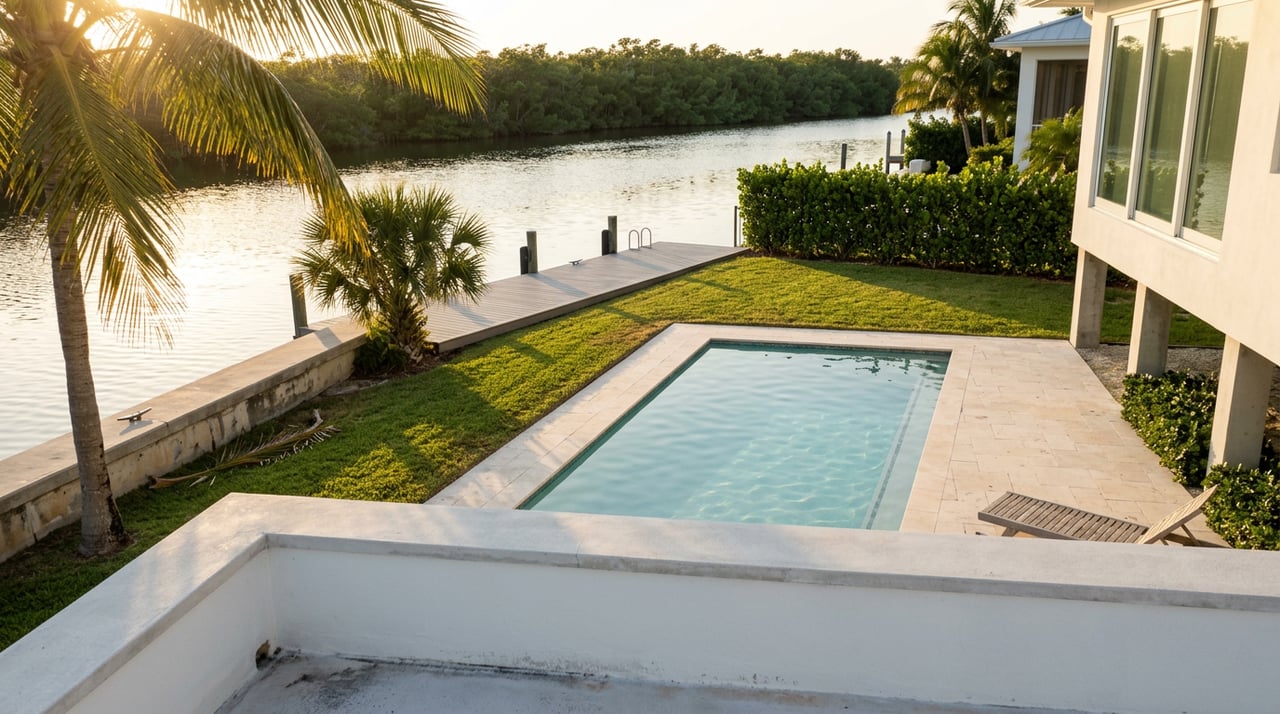
Two buyers, same budget, same kind of dock. One is shopping canal-front homes in Jupiter. The other is looking in Hobe Sound, inside Southern Martin County. Same AE flood zone. Same hurricane exposure. Same distance to the Intracoastal. When their insurance quotes come back, the numbers don't match, and the county line may be one factor, but it is not the only one.
That difference gets blamed on the usual suspects: roof age, elevation, a claim history nobody mentioned at the listing appointment. Sometimes it is one of those. But for waterfront buyers comparing Jupiter to Hobe Sound in Southern Martin County, there's a specific, dated policy difference worth checking before writing an offer.
The Flood Zone Doesn't Care Where the County Line Falls
Pull up a flood map along this stretch of coast and the zone designations don't respect municipal boundaries. Homes along the Intracoastal in Hobe Sound sit in Zone AE or VE for the same reason waterfront homes in Jupiter do: proximity to tidal water, storm surge exposure, and the same hurricane season every Florida homeowner budgets around. A canal lot in Hobe Sound and a canal lot in Jupiter carry comparable physical risk. The map doesn't change color at the county sign.
That's what makes the pricing gap worth digging into. If the underlying flood risk is roughly the same, the number on the declarations page should track closely too. It often doesn't.
Two Reports, Two Very Different Numbers for the Same County
Here's where a straight answer gets genuinely hard to find. One 2026 breakdown of Florida Office of Insurance Regulation data lists Martin County among the state's five most expensive counties for homeowners insurance, with an average premium of $5,993 a year, trailing only Monroe, Palm Beach, Broward, and Miami-Dade. A separate analysis, pulling from the same regulator's January 2025 stability report, puts Martin's countywide average at just $2,213, closer to inland counties like Baker or Highlands than to its coastal neighbors.
Both claim to come from the same state agency. Both can't be describing the same slice of the market.
The likely explanation is blending. "Martin County" as a single average folds oceanfront Hobe Sound together with inland Palm City and the ranchland west of I-95. Depending on which policies a given report samples and when it was pulled, that mix can swing the average by thousands of dollars. A countywide figure is a blend of very different risk profiles standing in for one number, which tells a waterfront buyer almost nothing about their specific canal lot.
Palm Beach County's average is more consistent across the reports we found, landing around $6,412 a year. But Jupiter is no more the Palm Beach County average than Hobe Sound is the Martin County average. The countywide number is a starting point for a conversation with an insurance agent, not a quote for a specific address.
| Waterfront market | Common flood zones | County homeowners avg (2026 estimates) | CRS class | Flood discount in a Special Flood Hazard Area |
|---|---|---|---|---|
| Jupiter, Palm Beach County | AE, VE | ~$6,412/year | Not confirmed at the Class 5 tier | Varies by town |
| Hobe Sound, Southern Martin County | AE, VE | $2,213 to $5,993/year, depending on the report | Class 5, unincorporated county, since 2023 | 25% in the flood hazard area, 10% outside it |
The One Number That Actually Explains Part of the Gap
Here's the piece that doesn't show up in a rate comparison chart, and it's specific enough to matter.
According to Martin County, the county earned an upgraded Community Rating System classification from FEMA in 2023, moving to Class 5. Under that rating, unincorporated Martin County property owners in a Special Flood Hazard Area, which covers most of the waterfront stock in Hobe Sound, receive a 25 percent discount on flood insurance premiums. Property owners outside the flood hazard area get a 10 percent discount. That isn't a promotional rate. It's a federal floodplain management credit.
The Community Rating System runs on a sliding scale. According to FEMA, a community that doesn't participate sits at Class 10 and gets no discount.
This matters for a specific reason. A buyer comparing a Hobe Sound canal home to a Jupiter canal home isn't just comparing two houses that happen to sit in similar flood zones. They're comparing two different floodplain management track records.
What This Actually Changes When You're Comparing Two Docks
None of this means Hobe Sound insures cheaper than Jupiter across the board, or that the decision should hinge on a CRS rating alone. A home's individual elevation certificate, roof age, and construction type still do most of the work in setting an actual premium. But it does mean the comparison most buyers make, these two towns look the same on paper so the insurance should be close, skips a real variable.
The practical move is to ask the specific question before writing an offer: what CRS class applies to this address, and what discount tier does that translate to on a flood policy. That number is public, and it can move a flood premium by thousands of dollars a year on a waterfront policy in a VE or AE zone, where flood-only premiums can otherwise run from roughly $2,000 to well over $10,000 depending on the zone and elevation.
The other variable worth checking before falling in love with a stretch of water is what the dock actually gets you. Direct oceanfront in Jupiter proper is limited. Most of the town's coastline sits behind private lots that face the Intracoastal or a canal rather than the sand itself, with the exception of the small stretch inside Jupiter Inlet Colony. Waterfront homes along the Loxahatchee River side of Jupiter typically have unrestricted ocean access, but a handful sit behind fixed bridges that cap boat height, which matters if a sailboat mast or a tall flybridge is part of the plan. Southern Martin County's Intracoastal and river frontage tends to open more directly toward blue water without that same bridge constraint on much of its length, which is worth confirming address by address rather than assuming.
None of this is a reason to pick one town over the other. It's a reason to ask sharper questions before an insurance binder shows up three weeks before closing and changes the math on a deal that already felt settled.
A Few Straight Answers
What should I check on the policy? You should confirm the community rating number on your policy matches what the county currently holds.
Should I choose a town based on flood insurance discount alone? No single variable should decide a waterfront purchase. But when two properties look comparable in flood zone and exposure, the CRS class is a real, quantifiable difference worth putting next to price, dock access, and everything else on the list before comparing final numbers.
Buying waterfront between Jupiter and the Treasure Coast means comparing more than square footage and dock length. If you want a straight read on what a specific address actually costs to insure, and what its dock and bridge situation really allows, Premier Properties of South Florida can walk the comparison with you property by property. Schedule a Consultation and bring the two addresses you're deciding between.
This article is general information, not legal, tax or financial advice. Consult a qualified professional about your situation.